Multidisciplinary management of a patient with synchronous neoplasms: A case report
of breast cancer plus pheochromocytoma
Article / Artículo
https://doi.org/10.33821/824
Date received: 10/10/2025
Date accepted: 18/1/2026
Date: 01/4/2026
1. Introduction
Synchronous neoplasms are defined as two or more malignant tumors of different histopathological
origins diagnosed within the first six months. This is considered a rare phenomenon;
the presence of multiple primary neoplasms is estimated to range between 0.73% and
11.7%. [1,2]. LV et al. [3] described the incidence of synchronous neoplasms in 161 patients, demonstrating
a high frequency of synchronism in gastric cancer (13%), lung cancer (12%), and esophageal
cancer (11.8%). Some studies report the prevalence of synchronous neoplasms ranging
from 15% to 34% in patients with breast cancer [4,5]. Other studies report a worse prognosis in this group of patients varies according
to clinical stage, histological grade, and treatment [6-8]. Chen et al. [9] described a difference greater than 10% in overall survival among patients with
colorectal cancer with synchronous tumors compared to patients with a single primary
tumor (61.9% vs. 73.7%, respectively).
The development of multiple neoplasms is associated with extrinsic patient-related
factors, such as harmful habits, occupational risks, level of physical activity, or
a combination of both. It is also associated with intrinsic factors, including immune
system alterations or genetic mutations in susceptibility genes, for instance, BRCA
and PTEN. [2, 10-11] In breast cancer, the presence of synchronous neoplasms has been associated with
radiotherapy and cytotoxic agents, which controversially constitute part of its treatment.
[2, 10]. A study conducted in Korea reports that patients with breast cancer and synchronous
neoplasms more frequently develop malignant tumors of the thyroid gland (71%) or the
gynecologic tract (9.7%) [12]. Additionally, other studies have reported a higher rate of synchronism in luminal
breast cancer and advanced-stage disease [13].
Herein, we present the case of a patient with two synchronous neoplasms-an atypical
combination of breast cancer and pheochromocytoma-and its multidisciplinary therapeutic
management.
2. Case Report
A 47-year-old postmenopausal woman with no relevant personal medical or surgical record
and no first-degree family history of cancer presented with a one-year palpable mass
in the right breast, associated over the past five months with sporadic episodes of
tachycardia and hot flashes.
On physical examination, a 4 x 4 cm, mobile, non-tender mass was palpated, with no
skin or nipple changes. Mammography revealed dense breasts, BI-RADS 2, and breast
ultrasound showed a solid hyperechoic lesion in the right breast with irregular margins,
measuring 17 x 15 mm, with no axillary lymphadenopathy.
Core needle biopsy revealed invasive breast carcinoma of no special type (NST). Immunohistochemistry
showed estrogen receptor positivity of 90%, progesterone receptor positivity of 80%,
HER2-negative status, and Ki-67 of 3%. As part of the preoperative workup, a contrast-enhanced
breast MRI was requested (Figure 1), revealing a lesion in the right breast measuring 5.6 x 4.2 x 2.8 cm, with no infiltration
of the skin or the nipple-areola complex.
Figure 1
Contrast-enhanced breast MRI: In the right breast, upper outer quadrant, anterior
and middle thirds (between the 8 and 12 o'clock positions and 2 cm from the nipple)
a mass-type lesion with irregular margins is identified. The lesion shows intermediate
T2 signal intensity, diffusion restriction, and early contrast enhancement with a
heterogeneous pattern and a persistent kinetic curve (type I). Peritumoral edema is
noted as adjacent to its posterior aspect. The lesion measures 5.6 * 4.2 * 2.8 cm
(AP * T * L diameters).
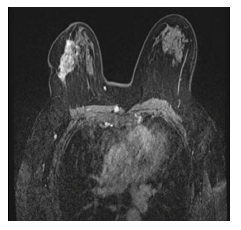
Source: Hospital Nacional Cayetano Heredia, Lima, Peru
Staging computed tomography scans revealed a right adrenal mass measuring 52 x 43
mm, with 30mm hypodense areas within the lesion. Subsequently, a contrast-enhanced
abdominal MRI described a right adrenal tumor measuring 5.4 * 3.8 * 3.8 cm, transverse-anteroposterior-craniocaudal
diameters (T-AP-CC), with a T1 hyperintense component and progressive T2 hypointensity,
which suggested hemorrhagic metastatic disease (Figure 2).
Figure 2
Contrast-enhanced abdominal MRI: A mass arising from the lateral limb and body of
the right adrenal gland is identified, measuring approximately 5.4 * 3.8 * 3.8 cm
(T * AP * CC diameters). The lesion shows a heterogeneous signal, with a central T1
hyperintense and T2 hypointense component, suggesting a hemorrhagic component. The
periphery demonstrates diffusion restriction and contrast enhancement predominantly
in the venous phases. No signal drop is observed on out-of-phase T1 gradient-echo
sequences, suggesting the absence of intralesional fat content.
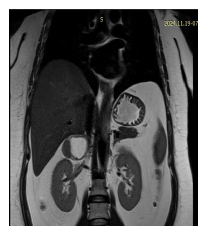
Source: Hospital Nacional Cayetano Heredia, Lima, Peru.
The patient was evaluated by the urologic oncology and endocrinology services, who
requested additional diagnostic studies. Tests revealed elevated serum and urinary
metanephrines, as well as increased chromogranin A levels. Those findings were consistent
with the diagnosis ofpheochromocytoma. Cardiovascular evaluation revealed no abnormalities
in blood pressure or cardiac rhythm.
Given the potential for cardiovascular complications caused by catecholamine release
from pheochromocytoma-such as tachyarrhythmias, hypertensive crises, among others-surgical
management was prioritized, and a right adrenalectomy via exploratory laparotomy was
performed. A combined surgical approach for both neoplasms was not undertaken due
to the patient's personal preference. The surgery was uneventful, and histological
confirmation of pheochromocytoma was obtained. Histopathological examination revealed
a mitotic index of 2 mitoses per 10 high-power fields, with no evidence of necrosis
or capsular or lymphovascular invasion. Immunohistochemistry showed synaptophysin
positivity, chromogranin positivity, focal S-100 positivity, and inhibin negativity.
Three months after the first surgery, a modified radical mastectomy was performed.
The pathological examination revealed an invasive breast carcinoma of no special type
(NST), with macroscopic measurements of 60mm, histological grade II, with presence
of lymphovascular invasion, probable perineural invasion, and lymph node involvement
(seven lymph nodes involved by neoplasia, three with macrometastases and four with
extranodal extension), staged as pT3 pN2 M0 (clinical stage IIIA and clinical prognostic
stage IIA).
Adjuvant chemotherapy was initiated with an anthracycline-based regimen. The patient
received four cycles of the AC regimen (Doxorubicin 60 mg/m2 and Cyclophosphamide 600 mg/m2) and experienced gastrointestinal toxicity (grade 3 nausea and grade 2 emesis), as
well as grade 2 asthenia.
She is currently receiving weekly Paclitaxel at a dose of 80 mg/rri2, with good tolerance
and no toxicities reported to date (a total of four cycles are planned). Subsequently,
hormone therapy with Anastrozole was indicated for a minimum of 5 years, along with
radiotherapy to the chest wall and axillary region.
3. Discussion
This is the first case reported in South America of a patient with synchronous neoplasms
of breast cancer and pheochromocytoma. This is an atypical event since only a few
cases have been reported in Europe and the United States [14,15]. Those patients presented with hormone receptor-positive breast cancer at stages
amenable to curative surgical management, like our patient.
Following the radical mastectomy, the patient presented with lymphatic dissemination.
A possible contributing factor is the delay in surgical management of this neoplasm,
as adrenalectomy had to be prioritized due to the cardiovascular risks associated
with pheochromocytoma. Given a 60-mm tumor with lymph node metastasis, the patient
is a candidate for adjuvant therapy with cyclin-dependent kinase inhibitors, such
as Abemaciclib [16,17] or Ribociclib [18,19], which have demonstrated a reduction in the risk of invasive disease recurrence
(33% at 5 years and 25% at 3 years, respectively) when combined with endocrine therapy.
Surgical management remains the best curative option for pheochromocytoma [20]. There is no indication for chemotherapy in early-stage disease, and even in advanced
stages, no consistent overall survival benefit has been observed, with overall response
rates (ORR) below 40% [21,22].
The patient's breast cancer was initially an early-stage disease with estrogen receptor
positivity and a low proliferative index, making a metastatic adrenal lesion less
likely. In the natural history of ductal breast carcinoma, metastases most frequently
occur in the bone (30%-62.5%), lung (11%-34%), liver (7.3%-32%), and central nervous
system (2%-16%); however, lobular histology may disseminate to more atypical sites,
such as the peritoneum or adrenal gland [23,24]. Nevertheless, a case of ductal breast cancer with solitary adrenal metastasis has
been reported [25]. Despite this rare association, pheochromocytoma should always be considered as
a diagnostic possibility.
4. Conclusion
Synchronous neoplasms pose a significant challenge for the diagnosis and management
of oncologic patients. Moreover, they are known to be associated with a poorer prognosis
and reduced survival. Understanding metastatic patterns and the natural history of
malignancies is essential to consider a broader spectrum of differential diagnoses,
as reports of patients with an association of these two neoplasms remain scarce.
The incidental detection of pheochromocytoma through imaging studies performed for
staging, together with its biochemical confirmation and timely surgical treatment,
highlights the importance of a multidisciplinary evaluation from the outset. Furthermore,
additional information is needed regarding the clinical presentation, diagnostic process,
and individualized management of these neoplasms to facilitate early identification
and optimize therapeutic strategies for patients.
5. Patient Perspective
In the first months following her diagnosis, the patient described in this case report
experienced depressive symptoms. She received therapy through the oncology psychology
service, resulting in improvement in her mood and mental health. According to the
patient, the most challenging aspect of her illness has been recovery from consecutive
surgeries. She is currently experiencing postoperative complications (abdominal incisional
hernia/eventration) secondary to the first surgery.
She experienced multiple toxicities during the initial cycles of chemotherapy; however,
she currently reports a sense of well-being and demonstrates good tolerance to systemic
treatment.
1. Introducción
Las neoplasias sincrónicas se definen como dos o más tumores malignos con diferente
origen histopatológico diagnosticadas dentro de los primeros seis meses. Suele ser
un fenómeno poco frecuente, la presencia de múltiples neoplasias primarias se estima
entre 0,73% y 11,7%. [1,2] Meng LV, et al. [3] describe la incidencia de neoplasias sincrónicas en 161 pacientes, donde se evidencia
una alta frecuencia de sincronismo en cáncer gástrico (13%), de pulmón (12%) y esófago
(11,8%). Algunos estudios reportan 15%-34% de neoplasias sincrónicas en pacientes
con cáncer de mama. [4,5]. Se reporta peor pronóstico en este grupo de pacientes, que varía según el estadio
clínico, el grado histológico y el tratamiento [6-8]. Huxian Chen, et al [9] describe una diferencia mayor del 10% en la sobrevida de pacientes con cáncer colorrectal
con tumores sincrónicos en comparación a pacientes con un solo tumor primario (61,9%
vs 73,7% respectivamente).
El desarrollo de neoplasias múltiples se asocia a factores extrínsecos del paciente,
como hábitos nocivos, riesgos ocupacionales, el nivel de actividad física o una combinación
de estos. También se asocia a factores intrínsecos como alteraciones del sistema inmune
o mutaciones genéticas en genes de susceptibilidad, entre ellos BRCA y PTEN [2, 10, 11]. En cáncer de mama, la presencia de neoplasias sincrónicas se asocia a radioterapia
y agentes citotóxicos que controversialmente forman parte de su tratamiento [2, 10]. Un estudio en Corea reporta que los pacientes con cáncer de mama y neoplasias sincrónicas
desarrollan con mayor frecuencia tumores malignos en la glándula tiroidea (71%) o
el tracto ginecológico (9,7%) [12]. Además, otros estudios asocian mayor tasa de sincronismo en el cáncer de mama luminal
y en estadio avanzado [13].
A continuación, se presenta el caso de una paciente con dos neoplasias sincrónicas
-una combinación atípica de un cáncer de mama con feocromocitoma- y su abordaje terapéutico
multidisciplinario.
2. Caso Clínico
Paciente mujer de 47 años, posmenopáusica, sin antecedentes personales médicos o quirúrgicos
relevantes y sin antecedentes oncológicos familiares de primer grado. La paciente
consulta por sensación de masa en la mama derecha de un año de evolución, asociada
desde hace cinco meses a episodios esporádicos de taquicardia y sofocos. Al examen
físico se palpa un tumor de 4 x 4 cm, móvil, no doloroso, sin alteración de la piel
ni del pezón. Su mamografía muestra mamas densas, BIRADS 2 y su ecografía una lesión
sólida hiperecogénica en mama derecha, de márgenes irregulares, que mide 17 x 15mm,
sin adenopatías axilares. La biopsia informa un carcinoma mamario infiltrante sin
tipificación específica (NST), la inmunohistoquímica reporta receptores de estrógeno
(90%), receptores de progesterona (80%), HER2 negativo y ki-67: 3%. Como estudio prequirúrgico,
se solicita una RMN de mamas contrastada (Figura 1) en la que se evidencia una lesión en mama derecha de 5,6 x 4,2 x 2,8 cm, sin infiltración
de piel ni del complejo areola-pezón. Se realizan tomografías de extensión donde se
evidencia en glándula suprarrenal derecha una tumoración de 52 x 43mm con áreas hipodensas
de 30 mm en su interior. Se realiza RMN abdominal contrastada donde se describe una
tumoración suprarrenal derecha de 5.4 x 3.8 x 3.8 cm, (diámetros T-AP-CC), con componente
hiperintenso en T1 e hipointensidad declive en T2 que sugiere posibilidad de metástasis
hemorrágica (Figura 2).
Figura 1
RMN de mamas con contraste: en el cuadrante superoexterno de la mama derecha (tercio
anterior y medio, radios 8-12, a 2 cm del pezón), se evidencia una lesión tipo masa,
con márgenes irregulares, señal intermedia en T2 y restricción de la difusión. Presenta
realce precoz del contraste con un patrón heterogéneo y una curva cinética persistente
(tipo I). Se asocia edema peritumoral adyacente a su aspecto posterior; dimensiones
de 5,6 * 4,2 * 2,8 cm (diámetros AP * T * L).
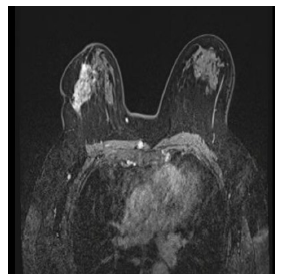
Fuente: Hospital Nacional Cayetano Heredia, Lima, Perú.
Figura 2
RMN de abdomen con contraste: se identifica tumoración dependiente del brazo lateral
y cuerpo de glándula suprarrenal derecha, de aproximadamente 5,4 * 3,8 * 3,8 cm (diámetro
T * AP * CC). Presenta una señal heterogénea con un componente central hiperintenso
en T1 e hipointenso en T2, lo que sugiere componente hemorrágico. La periferia muestra
restricción a la difusión y realce con predominio de las fases venosas. No se observa
caída de señal en la secuencia ecogradiente T1 fuera de fase que sugiera contenido
graso intralesional.
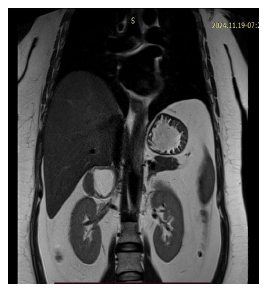
Fuente: Hospital Nacional Cayetano Heredia, Lima, Perú.
La paciente es valorada por los servicios de urología oncológica y endocrinología,
quienes solicitan estudios complementarios. En dichos exámenes se evidencia elevación
de metanefrinas séricas y urinarias, así como de cromogranina A; hallazgos compatibles
con el diagnóstico de feocromocitoma. En la evaluación cardiovascular no se identifican
alteraciones de la presión arterial ni del ritmo cardíaco.
Ante la posibilidad de complicaciones cardiovasculares causadas por liberación de
catecolaminas del feocromocitoma -como taquiarritmias, picos hipertensivos, entre
otras-, se priorizó la adrenalectomía derecha mediante laparotomía exploratoria. No
se realizó una cirugía conjunta para ambas neoplasias por decisión de la paciente.
La cirugía no tuvo complicaciones y se pudo obtener confirmación histológica de feocromocitoma.
El estudio histopatológico evidenció un índice mitótico de 2 mitosis por cada 10 campos
de alto poder, ausencia de necrosis e invasión capsular o linfovascular. Se cuenta
con inmunohistoquímica en la cual se evidencia sinaptofisina positivo, cromogranina
positivo, S-100 positivo focal e inhibina negativa.
Tres meses después de la primera cirugía, se realizó la mastectomía radical modificada
y el estudio anatomopatológico reportó un carcinoma invasivo de mama NST de 60 mm
(macroscópico), grado histológico II, invasión linfovascular presente, invasión perineural
probable, con extensión ganglionar (siete ganglios comprometidos por neoplasia, tres
con macrometástasis y cuatro con extensión macronodal), pT3pN2M0 (estadio clínico
IIIA y estadio de pronóstico clínico IIA). Se inició quimioterapia adyuvante a base
de antraciclinas, ha recibido cuatro ciclos de doxorrubicina a 60 mg/m2 y ciclofosfamida
a 600 mg/m2 (esquema AC); presentó toxicidad gastrointestinal (náuseas grado 3 y emesis
grado 2), además de astenia grado 2. Actualmente recibe paclitaxel semanal a dosis
de 80 mg/m2 con una adecuada tolerancia, sin toxicidades registradas hasta el momento
(recibirá un total de cuatro ciclos). Posteriormente se indicó inicio de hormonoterapia
con anastrozol por un mínimo de cinco años y radioterapia en pared torácica y región
axilar.
3. Discusión
Este es el primer caso descrito en Sudamérica de una paciente con neoplasias sincrónicas
de cáncer de mama y feocromocitoma; por tanto, es un evento atípico, solo existen
casos reportados en Europa y Estados unidos [14 - 15], que presentan similitudes con este caso: cáncer de mama con receptores hormonales
positivos y en estadios abordables para manejo quirúrgico curativo.
Luego de la mastectomía radical, la paciente presentó diseminación linfática, una
posible causa es la demora del manejo quirúrgico de esta neoplasia ya que se tuvo
que priorizar la adrenalectomía por los riesgos cardiovasculares del feocromocitoma.
Al tener un tumor de 60 mm con metástasis ganglionar, la paciente es candidata para
recibir terapia adyuvante con inhibidores de ciclinas como abemaciclib [16 - 17] o ribociclib [18 - 19] los cuales han demostrado disminuir la recurrencia de enfermedad invasiva (33% a
los 5 años y 25% a los 3 años respectivamente) asociado a terapia endocrina. El manejo
quirúrgico es la mejor opción curativa para el feocromocitoma [20], no existe indicación de quimioterapia en estadios tempranos, incluso en estadios
avanzados no se observa un beneficio constante en supervivencia global, además de
tasas de respuesta global (TRG) menor del 40% [21, 22].
El cáncer de mama de la paciente era inicialmente un estadio temprano con receptores
estrogénicos positivos y un bajo grado de replicación, por lo que no se sospechaba
de una tumoración suprarrenal de origen metastásico. En la historia natural del carcinoma
ductal de mama se evidencia mayor frecuencia de metástasis a huesos (30% - 62,5%),
pulmón (11% - 34%), hígado (7,3% - 32%), y sistema nervioso central (2% - 16%). No
obstante, la histología lobulillar puede diseminar a lugares más atípicos como peritoneo
o glándula suprarrenal. [23 - 24]. Sin embargo, se ha reportado una paciente con cáncer de mama ductal con metástasis
solitaria a nivel suprarrenal [25], a pesar de su rara asociación, el feocromocitoma siempre debe considerarse como
una posibilidad diagnostica.
4. Conclusión
Las neoplasias sincrónicas representan un desafío para el diagnóstico y tratamiento
de pacientes oncológicos; además, es sabido que tal desafío se asocia a un pobre pronóstico
y peor supervivencia. Es importante saber los patrones de metástasis y la historia
natural de las enfermedades para poder pensar en un mayor espectro de diagnósticos
diferenciales, pues son pocos los casos reportados de pacientes con asociación de
estas dos neoplasias.
El hallazgo incidental de feocromocitoma mediante estudios de imagen realizados para
estadiaje, junto con su confirmación bioquímica y tratamiento quirúrgico oportuno,
resalta la importancia de una evaluación multidisciplinaria desde el inicio. Asimismo,
se requiere más información sobre la presentación clínica, el proceso diagnóstico
y el manejo individualizado de estas neoplasias, con el fin de favorecer su identificación
temprana y optimizar el abordaje terapéutico de los pacientes.
5. Perspectiva de paciente
En los primeros meses luego de su diagnóstico, la paciente de este caso clínico presentó
sentimientos depresivos, por lo cual recibió terapia en el servicio de psicología
para pacientes oncológicos, con mejoría de su estado de ánimo y salud mental. Según
la paciente, lo más retador de su enfermedad ha sido la recuperación de una cirugía
tras otra, con complicaciones posquirúrgicas (eventración abdominal) secundarias a
la primera cirugía. Presentó múltiples toxicidades durante sus primeros ciclos de
quimioterapia. Actualmente se encuentra con sensación de bienestar y presenta una
adecuada tolerancia a su tratamiento sistémico.