Prevalence of multi-resistant bacteria associated with febrile neutropenia in pediatric
oncology patients
Article / Artículo
https://doi.org/10.33821/827
Date received: 23/10/2025
Date accepted: 18/3/2026
Date: 04/1/2026
1. Introduction
Research on the prevalence of multidrug-resistant bacteria associated with febrile
neutropenia in oncology patients has been an extensively addressed topic in the scientific
literature, contributing valuable data on the epidemiology and management of these
conditions in vulnerable populations. Antimicrobial resistance (AMR) constitutes a
global health crisis that threatens the advances achieved by modern medicine. In this
context, the World Health Organization (WHO) updated its Bacterial Priority Pathogens
List (BPPL) in 2024. It includes 24 pathogens grouped into 15 antibiotic-resistant
families, classified into three categories: critical, high, and medium priority [1,2]. Within the critical priority category, there are ESBL-producing Enterobacteriaceae,
Klebsiella pneumoniae, and carbapenem-resistant Acinetobacter baumannii [1,2]. These pathogens are directly implicated in the findings of the present study. Microorganisms
included in these groups are associated with high morbidity and mortality and substantially
increase the cost of medical care [1].
This growing concern has underscored the urgent need to investigate the impact of
AMR in high-risk populations, particularly pediatric oncology patients. Febrile neutropenia
is a frequent and potentially life-threatening complication in cancer patients undergoing
chemotherapy; in the pediatric population, it is of particular relevance due to its
association with significant morbidity and mortality [3,4].
This study aimed to determine the prevalence of multidrug-resistant bacteria associated
with episodes of febrile neutropenia in pediatric oncology patients treated at the
Baca Ortíz Pediatric Hospital between 2019 and 2023, thus contributing to the revision
and updating of institutional empirical antibiotic therapy protocols.
2. Materials and Methods
2.1 Study design
A non-experimental, quantitative, descriptive study was conducted using an observational,
cross-sectional, and retrospective design based on the analysis of electronic medical
records of previously treated patients, with no direct intervention on study participants.
2.2 Setting, population, and sample
The study was carried out at the Oncohematology Service of the Baca Ortíz Pediatric
Hospital (Ministry of Public Health), Quito, Ecuador, a national tertiary referral
center for the pediatric population. Electronic records from January 2019 to December
2023 were analyzed. Data collection was completed in December 2024. The study was
approved by the Institutional Review Board for Human Research (CEISH-HPBO) under code
021-CEISH-HPBO-PA-2024.
The study population comprised pediatric patients aged 0 to 15 years with a confirmed
oncologic diagnosis, who experienced at least one episode of febrile neutropenia with
a positive blood culture during the specified period. All records meeting the selection
criteria were included; therefore, there was a complete census of eligible cases.
Inclusion criteria were age between 0 and 15 years; confirmed oncologic diagnosis
(solid tumors or hematologic malignancies); at least one episode of febrile neutropenia,
defined as temperature ≥38°C with an ANC ≤500/mm3 or ≤1,000/mm3 with an expected decline to below 500/mm3 within 24 to 48 hours; a positive blood culture; and a complete clinical record.
Each patient was included only once, based on the first documented episode; recurrent
episodes were not included.
Records were excluded if they contained incomplete data, lacked a final blood culture
result, corresponded to patients older than 15 years, or did not strictly fulfill
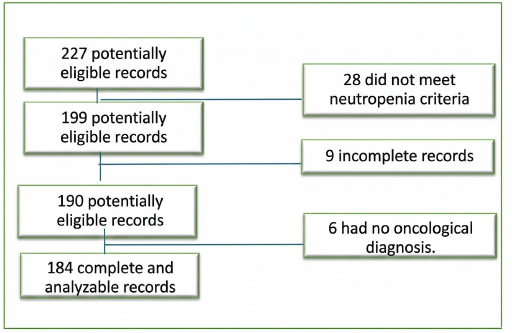
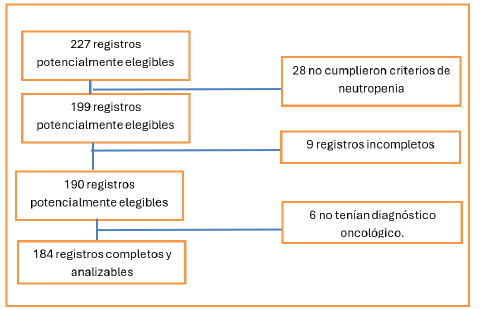
the criteria for febrile neutropenia or lacked an oncologic diagnosis. Of 227 potentially
eligible records, 43 were excluded (28 because they did not meet febrile neutropenia
criteria, 9 had incomplete records, and 6 for absence of an oncologic diagnosis),
thus resulting in 184 records included in the final analysis. These represented the
complete universe of eligible cases for the study period (Figure 1).
Figure 1
Participant selection flowchart. Of 227 potentially eligible records, 43 were excluded
because they did not meet neutropenia criteria (n=28), had incomplete records (n=9),
or absence of an oncologic diagnosis (n=6), thus resulting in 184 records included
in the final analysis.
2.3 Variables
Variables analyzed included sociodemographic characteristics (age stratified in months,
and biological sex), clinical characteristics (oncologic diagnosis [leukemia, lymphoma,
and solid tumor]; neutropenia grade, classified as mild [ANC 1,000-1,500/mm3], moderate [ANC 500-1,000/mm3], and severe [ANC <500/ mm3]; and oral or axillary temperature ≥38 °C), and microbiological characteristics (microorganism
isolated in blood culture; ESBL production; carbapenemase production; and classification
as a multidrug-resistant organism). Categorical variables are presented with their
respective categories; continuous variables were stratified for descriptive analysis.
2.4 Statistical analysis
Univariate descriptive analysis was performed for all variables using absolute frequency
tables and percentages. To explore the distribution of microbiological variables according
to oncologic diagnosis and neutropenia grade, contingency tables were constructed.
Given the cross-sectional descriptive design and the census-based approach, 95% confidence
intervals (CIs) were calculated for MDR prevalence estimates to assess the precision
of findings. Records with incomplete data were excluded during the selection phase;
therefore, no missing data were present in the final analysis. IBM SPSS Statistics
version 23 was used for all statistical analyses.
2.5 Bias control
Strict inclusion and exclusion criteria were applied to minimize selection bias. Records
with incomplete clinical histories, those lacking final blood culture results, patients
older than 15 years, and those who did not strictly meet febrile neutropenia criteria
or had non-oncologic diagnoses were excluded.
Sample size: A total of 227 potentially eligible records were initially identified.
Of these, 43 were excluded for failure to meet selection criteria: 28 did not fulfill
febrile neutropenia criteria, 9 were incomplete, and 6 lacked an oncologic diagnosis.
The final sample comprised 184 complete records.
3. Results
A total of 184 electronic records meeting the established criteria were identified
(Figure 1). Each record corresponded to a single patient with one episode of febrile neutropenia
and one positive blood culture; therefore, the unit of analysis was simultaneously
the patient and the microbiological isolate. Recurrent episodes from the same patient
were not included. Accordingly, prevalence per patient and prevalence per isolate
are equivalent, both calculated on a denominator of 184 cases.
Female patients accounted for 51.6% of the cohort and male patients for 48.4%. The
most frequently represented age group was 121 to 180 months old (10 to 15 years),
comprising 33.2% of the population. Leukemia was the predominant oncologic diagnosis
(84.8%), followed by lymphoma and solid tumors (Table 1).
Table 1
Distribution by diagnosis
|
Diagnosis
|
Frequency
|
Percentage
|
|
Leukemia
|
156
|
84.8 %
|
|
Lymphoma
|
14
|
7.6 %
|
|
Solid tumor
|
14
|
7.6 %
|
|
Total
|
184
|
100.0%
|
More than 90% of patients presented severe neutropenia. 78.3% belonged to the leukemia
group, while patients with lymphoma and solid tumors predominantly exhibited mild
to moderate neutropenia (Table 2).
Table 2
Sample distribution by level of neutropenia and cancer diagnosis
|
|
|
|
Leukemia
|
Lymphoma
|
Solid tumor
|
Total
|
|
Neutropenia level
|
MILD
|
Count
|
4
|
1
|
0
|
5
|
|
|
Percentage |
2.2 %
|
0.5 %
|
0.0 %
|
2.7 %
|
|
MODERATE
|
Count
|
8
|
3
|
1
|
12
|
|
|
Percentage |
4.3 %
|
1.6 %
|
0.5 %
|
6.5 %
|
|
SEVERE
|
Count
|
144
|
10
|
13
|
167
|
|
|
Percentage |
78.3 %
|
5.4 %
|
7.1 %
|
90.8 %
|
|
|
Count
|
156
|
14
|
14
|
184
|
|
Total
|
|
Percentage |
7.6 %
|
8.4 %
|
7.6%
|
100.0 %
|
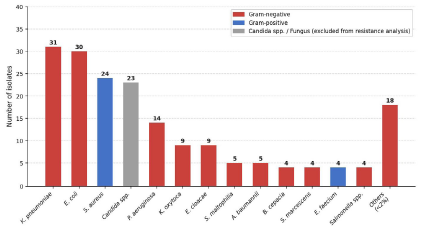
Of the 184 total isolates, 160 (87.0%) were bacterial and 24 (13.0%) were fungal,
including Candida spp. (23 cases, 12.5%) and Rhodotorula sp. (1 case, 0.5%). Fungal isolates were excluded from the bacterial resistance analysis.
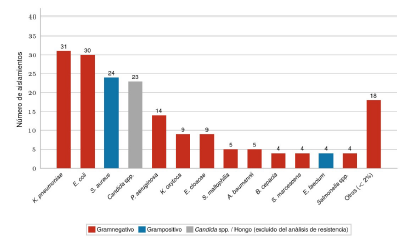
Among bacterial isolates, Gram-negative organisms predominated (127 cases, 69.0%).
Klebsiella pneumoniae (kpn) was the most frequently isolated microorganism with 31 cases (16.8%), followed
by Escherichia coli (eco), 30 cases (16.3%); Pseudomonas aeruginosa (pae), 14 cases (7.6%); Enterobacter cloacae (ecl), 9 cases (4.9%); Klebsiella oxytoca (kox), 9 cases (4.9%); and Acinetobacter baumannii (aba), 5 cases (2.7%). Among Gram-positive bacteria (33 cases, 17.9%), Staphylococcus aureus (sau) was the most frequently isolated species with 24 cases (13.0%). All remaining
microorganisms had individual frequencies below 2.5% (Figure 2).
Figure 2
Frequency of microorganisms identified in blood cultures from patients with febrile
neutropenia, according to microbiological classification (n=184). Red bars represent
Gram-negative bacteria, blue bars Gram-positive bacteria, and grey bars fungi. Values
above each bar indicate the absolute number of isolates. Fungal isolates were excluded
from the bacterial resistance analysis.
Source: Authors' own elaboration.
Resistance analysis was performed on the 160 bacterial isolates, excluding the 24
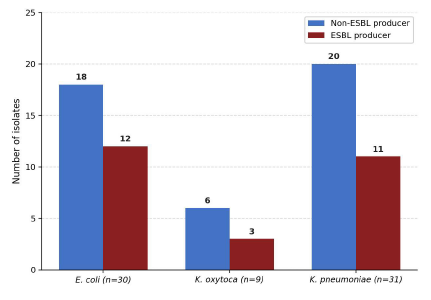
fungal isolates. The prevalence of ESBL-producing bacteria was 16.0% (95% CI: 10.0%-22.0%),
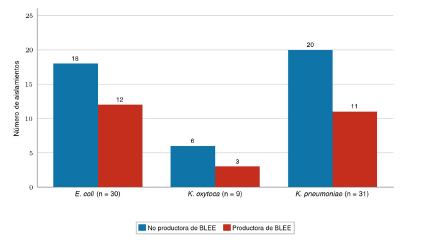
calculated on this denominator. Regarding species distribution, Escherichia coli (eco) had the highest frequency of ESBL production with 12 cases (40.0% of its isolates),
followed by Klebsiella pneumoniae (kpn) with 11 cases (35.5%), and Klebsiella oxytoca (kox) with 3 cases (33.3%). It should be noted that kpn and kox are Enterobacteriaceae,
while the remaining ESBL-producing cases corresponded to other Gram-negative bacteria
with individual counts below 2 cases (Figure 3).
Figure 3
Distribution of ESBL-producing isolates by bacterial species. Blue bars represent
non-producing isolates, red bars represent ESBL-producing isolates. Values above each
bar indicate the absolute number of isolates. E. coli n=30 (40.0% ESBL-producing); K. pneumoniae n=31 (35.5% ESBL-producing); K. oxytoca n=9 (33.3% ESBL-producing).
Source: Authors' own elaboration.
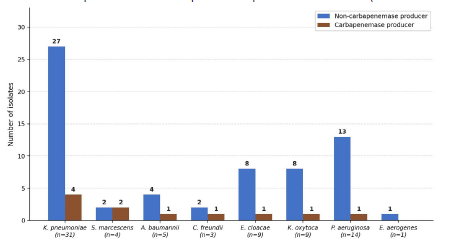
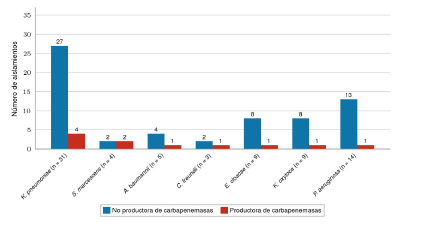
Regarding carbapenemase production, a total of 12 cases were identified (8.0%; 95%
CI: 3.0%-12.0%). Klebsiella pneumoniae (kpn) was the most frequently implicated species with 4 cases (33.3% of carbapenemase-producing
isolates), followed by Serratia marcescens (sma) with 2 cases (16.7%). The remaining 6 cases were distributed among Acinetobacter baumannii (aba), Citrobacter freundii (cfr), Enterobacter cloacae (ecl), Klebsiella oxytoca (kox), Pseudomonas aeruginosa (pae), and Enterobacter aerogenes (eae) with one each (Figure 4).
Figure 4
Distribution of carbapenemase-producing isolates by bacterial species (n=160) in pediatric
oncology patients with febrile neutropenia. Blue bars represent non-producing isolates,
red bars represent carbapenemase-producing isolates. Values above each bar indicate
the absolute number of isolates. The overall prevalence of carbapenemase production
was 8.0% (95% CI: 3.0%-12.0%).
Source: Authors' own elaboration.
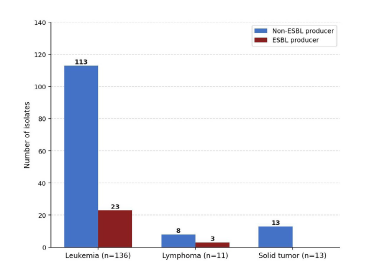
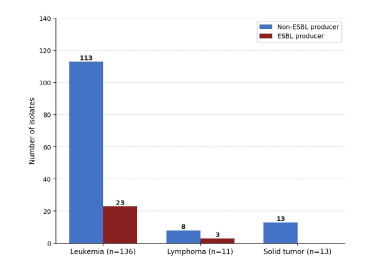
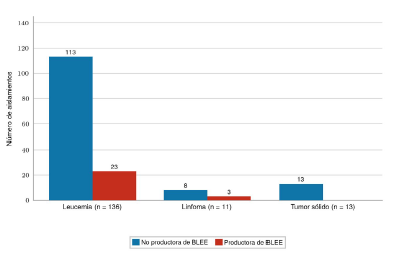
When stratified by oncologic diagnosis, the prevalence of ESBL-producing organisms
was 16.9% among patients with leukemia (n=23), 27.3% among those with lymphoma (n=3),
and 0.0% among those with solid tumors (Figure 5).
Figure 5
Distribution of ESBL-producing bacterial isolates by oncologic diagnosis (n=160).
Blue bars represent non-producing isolates, red bars represent ESBL-producing isolates.
Values above each bar indicate the absolute number of isolates. Leukemia: 16.9% ESBL;
Lymphoma: 27.3% ESBL; Solid tumor: 0.0% ESBL.
Source: Authors' own elaboration.
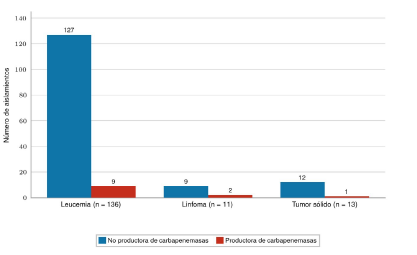
Regarding carbapenemase production, prevalence was 6.6% among patients with leukemia
(n=9), 18.2% among those with lymphoma (n=2), and 7.7% among those with solid tumors
(n=1) (Figure 6).
Figure 6
Distribution of carbapenemase-producing bacterial isolates by oncologic diagnosis
(n=160). Blue bars represent non-producing isolates, red bars represent carbapenemase-producing
isolates. Values above each bar indicate the absolute number of isolates. Leukemia:
6.6%; Lymphoma: 18.2%; Solid tumor: 7.7%.
Source: Authors' own elaboration.
4. Discussion
Findings of the present study reveal a microbiological profile dominated by Gram-negative
bacteria in pediatric oncology patients with febrile neutropenia. Klebsiella pneumoniae (kpn) was the most frequently isolated pathogen (16.8%), followed by Escherichia coli (eco) (16.3%), and Pseudomonas aeruginosa (pae) (7.6%). Within this group, kpn and eco are Enterobacteriaceae, whereas P. aeruginosa (pae) and Acinetobacter baumannii (aba) are non-fermenting Gram-negative bacilli-a taxonomically relevant distinction
for empirical treatment selection. This pattern is consistent with trends documented
in the contemporary literature [5,6,7]. Islas-Muñoz et al. [8] in a Mexican cohort of oncology patients reported Escherichia coli as the most frequent pathogen in bacteremia, accounting for 42.3% of isolates, while
Babu et al. [9] in India identified a similar pattern with predominance of E. coli, A. baumannii, and K. pneumoniae.The convergence of these findings suggests a consistent epidemiological trend toward
the predominance of Gram-negative bacteria-both fermenting and non-fermenting-in this
patient population.
Regarding resistance profiles, the prevalence of ESBL-producing bacteria was 16.0%
(95% CI: 10.0%-22.0%) and that of carbapenemase-producing bacteria was 8.0% (95% CI:
3.0%-12.0%), both calculated on 160 bacterial isolates after excluding the 24 fungal
isolates. These figures are clinically significant, particularly given that ESBL-
and carbapenemase-producing Gram-negative bacteria-including Enterobacteriaceae and
non-fermenting bacilli-are listed under the critical priority category of the 2024
WHO Bacterial Priority Pathogens List [1,2]. The carbapenemase prevalence identified in this study falls at the lower end of
the 3%-51% range reported by Balletto et al. [10] across different European regions, which may reflect differences in antibiotic stewardship
policies and local epidemiological surveillance systems. Nevertheless, even low prevalences
of carbapenem resistance carry substantial clinical implications in immunocompromised
populations, given the limited therapeutic armamentarium available for their management
[1,7].
The distribution of resistance by oncologic diagnosis demonstrated that patients with
leukemia concentrated the highest frequency of infections due to ESBL-producing (16.9%)
and carbapenemase-producing (6.6%) organisms. This finding is consistent with the
greater chemotherapy intensity and depth of neutropenia characteristically observed
in this disease [4]. More than 90% of patients in this cohort presented with severe neutropenia, a proportion
exceeding that reported by Gavidia Mayora et al. [11] in Guatemala (72.77%). This difference may be explained by the characteristics of
the population served at a national tertiary referral center.
Regarding infection etiology, literature documents a historical evolution in microbiological
profiles: from the predominance of Gram-negative organisms in the 1960s and 1970s,
to a shift toward Grampositive bacteria from the mid-1980s onward [5]. Subsequently, there was a resurgence of multidrug-resistant Gram-negative organisms
since the year 2000 driven by the dissemination of resistance genes encoding ESBLs
and carbapenemases [6,7]. This study reflects the most recent phase, which is characterized by a predominantly
Gram-negative profile and a significant presence of MDR mechanisms that must be taken
into account in therapeutic decision-making.
It is important to note that, while these findings provide valuable information on
the local epidemiology of bacterial resistance in pediatric oncologic febrile neutropenia,
the development of empirical antibiotic therapy protocols requires integrating multiple
clinical and institutional variables, including the local antimicrobial susceptibility
profile, the patient's clinical status, tumor type, treatment intensity, and available
resources. Therefore, results of the present study should be interpreted as a complementary
input for the review of institutional guidelines, and not as independent evidence
sufficient to modify protocols [2,5,7].
4.1 Limitations
This study has several limitations that should be considered when interpreting results.
First, given the retrospective design, data quality was contingent upon the completeness
of available electronic records, which may have required excluding 43 records due
to incomplete data or absence of an oncologic diagnosis. Second, the single-center
design limits the generalizability of findings to other institutional or geographic
contexts, as antimicrobial resistance patterns may vary substantially across hospitals
and regions. Third, the lymphoma and solid tumor subgroups had small sample sizes,
thus resulting in wide confidence intervals for their stratified estimates and limiting
the precision of comparisons across oncologic diagnoses. Finally, given the descriptive
cross-sectional design, causal relationships could not be established, nor could the
impact of bacterial resistance on clinical outcomes such as mortality or length of
hospitalization be assessed.
5. Conclusions
This study identified a predominance of Gram-negative bacteria in blood cultures from
pediatric oncology patients with febrile neutropenia. Enterobacteriaceae Klebsiella pneumoniae and Escherichia coli were the most frequently isolated pathogens, followed by the non-fermenting bacillus
Pseudomonas aeruginosa. Leukemia was the predominant oncologic diagnosis; it also concentrated the highest
proportion of cases with severe neutropenia and multidrug-resistant bacterial isolates.
The presence of ESBL-producing and carbapenemase-producing bacteria both included
in the critical priority category of the 2024 WHO Bacterial Priority Pathogens List
underscores the clinical relevance of these findings in a particularly vulnerable
population. ESBL production was the most prevalent MDR mechanism, occurring at a higher
frequency than carbapenemase production.
Results contribute to characterizing the local microbiological landscape of bacterial
resistance associated with febrile neutropenia in pediatric oncology patients at the
Baca Ortíz Pediatric Hospital and may serve as a basis for the revision and updating
of institutional empirical antibiotic therapy protocols. Given the descriptive, single-center
nature of the study, these conclusions should be interpreted with caution and supplemented
by multicenter research to broaden their scope and applicability.
1. Introducción
La investigación sobre la prevalencia de bacterias multirresistentes asociada a neutropenia
febril en pacientes oncológicos ha sido un tema relevante en la literatura científica,
y ha aportado información valiosa sobre la epidemiología y el manejo de estas patologías
en poblaciones vulnerables. La resistencia a los antimicrobianos constituye una crisis
sanitaria global que compromete los avances alcanzados por la medicina moderna. En
este contexto, la Organización Mundial de la Salud (OMS) actualizó en el 2024 su Lista
de Patógenos Bacterianos Prioritarios (BPPL), que incluye 24 patógenos agrupados en
15 familias resistentes a antibióticos, clasificados en tres categorías: crítica,
alta y media [1,2]. Dentro de la categoría crítica se ubican enterobacterias productoras de betalactamasas
de espectro extendido (BLEE): Klebsiella pneumoniae y Acinetobacter baumannii resistente a carbapenémicos [1,2], patógenos directamente relacionados con los hallazgos del presente estudio. Los
microorganismos incluidos en estos grupos causan alta morbilidad y mortalidad, lo
que incrementa los costos de la atención médica [1].
Esta creciente preocupación ha subrayado la necesidad urgente de investigar y comprender
la resistencia antimicrobiana en poblaciones sensibles, como los pacientes oncológicos
pediátricos. La neutropenia febril es un evento crítico frecuente en pacientes oncológicos
bajo tratamiento quimioterápico que, en la población pediátrica, adquiere particular
relevancia por su asociación con alta morbilidad y mortalidad [3,4].
Este estudio tuvo como objetivo determinar la prevalencia de bacterias multirresistentes
asociadas a episodios de neutropenia febril en pacientes pediátricos oncológicos atendidos
en el Hospital Pediátrico Baca Ortiz durante el periodo 2019-2023, con el fin de contribuir
a la actualización de protocolos de terapia antibiótica empírica institucional.
2. Materiales y métodos
2.1 Diseño del estudio
Se realizó un estudio observacional, transversal y retrospectivo, con base en el análisis
de registros electrónicos de pacientes previamente atendidos sin intervención sobre
ellos.
2.2 Escenario, población y muestra
El estudio se llevó a cabo en el servicio de Oncohematología del Hospital Pediátrico
Baca Ortiz, Quito, Ecuador, centro de referencia nacional de tercer nivel para la
población pediátrica. Se analizaron los registros electrónicos correspondientes al
periodo enero 2019-diciembre 2023, y el análisis se completó en diciembre del 2024.
El estudio contó con la aprobación del Comité de Ética en Seres Humanos del Hospital
Pediátrico Baca Ortiz (CEISH-HPBO) con el Código 021-CEISH-HPBO-PA-2024.
La población de estudio estuvo constituida por pacientes pediátricos de 0 a 15 años
con diagnóstico oncológico confirmado que presentaron al menos un episodio de neutropenia
febril con hemocultivo positivo durante el periodo señalado. Se trabajó con la totalidad
de los registros que cumplieron los criterios de selección y que constituyeron un
censo de casos elegibles.
Los criterios de inclusión fueron edad entre 0 y 15 años; diagnóstico oncológico confirmado
(tumores sólidos o neoplasias hematológicas); al menos un episodio de neutropenia
febril definida como temperatura ≥ 38 °C con recuento absoluto de neutrófilos (RAN)
≤ 500/mm3 o ≤ 1000/mm3 con expectativa de descenso a menos de 500/mm3 en las siguientes 24-48 horas; hemocultivo positivo, y registro clínico completo.
Cada paciente fue incluido una única vez considerando el primer episodio documentado;
los episodios repetidos no fueron incluidos.
Se excluyeron los registros con información incompleta, aquellos sin resultado final
de hemocultivo, los pacientes mayores de 15 años y los que no cumplían los criterios
exactos de neutropenia febril o carecían de diagnóstico oncológico. De 227 registros
potencialmente elegibles, se excluyeron 43 (28 por no cumplir criterios de neutropenia
febril, 9 por ser registros incompletos y 6 por ausencia de diagnóstico oncológico).
El resultado fue de 184 registros incluidos en el análisis final, correspondientes
al universo completo de casos elegibles del periodo (Figura 1).
Figura 1
Diagrama de flujo de selección de los participantes. De los 227 registros potencialmente elegibles, se excluyeron 43 por no cumplir criterios
de neutropenia (n=28), registros incompletos (n=9) o ausencia de diagnóstico oncológico
(n=6), resultando en 184 registros incluidos en el análisis.
2.3 Variables
Las variables analizadas incluyeron características sociodemográficas (edad estratificada
en meses y sexo biológico); clínicas (diagnóstico oncológico: leucemia, linfoma y
tumor sólido; grado de neutropenia clasificado en leve 1000-1500/mm3, moderada 500-1000/mm3 y severa < 500/mm3); temperatura oral o axilar ≥ 38 °C, y microbiológicas (microorganismo aislado en
hemocultivo, producción de BLEE, producción de carbapenemasas y clasificación como
bacteria multirresistente). Las variables cualitativas se presentaron con sus categorías
y las cuantitativas fueron estratificadas para su análisis descriptivo.
2.4 Análisis estadístico
Se realizó análisis descriptivo univariante para todas las variables por medio de
tablas de frecuencia absolutas y porcentajes. Para explorar la distribución de las
variables microbiológicas según diagnóstico oncológico y grado de neutropenia se construyeron
tablas de contingencia. Dado el diseño descriptivo transversal y el abordaje censal,
se calcularon intervalos de confianza al 95 % para prevalencias de multirresistencia
con el fin de estimar la precisión de los hallazgos. Los registros con datos incompletos
fueron excluidos durante la selección, por lo que no se registraron datos faltantes
en el análisis final. Se utilizó el paquete estadístico IBM SPSS Statistics versión
23.
2.5 Control de fuentes de sesgo
Se aplicaron criterios de inclusión y exclusión estrictos para controlar el sesgo
de selección. Se excluyeron registros con historias clínicas incompletas, aquellos
que carecían de resultados finales de hemocultivos, pacientes mayores de 15 años y
aquellos que no cumplían los criterios exactos de neutropenia febril o que tenían
diagnósticos no oncológicos.
Tamaño muestral: Inicialmente se incluyó un total de 227 potencialmente elegibles
para el estudio. De estos, 43 registros fueron excluidos por no cumplir con los criterios
de selección: 28 no cumplieron los criterios de neutropenia febril, 9 estaban incompletos,
y 6 no tenían diagnóstico oncológico. Por lo tanto, la muestra final fue de 184 registros
completos.
3. Resultados
Cada uno de los 184 registros correspondió a un único paciente (Figura 1) con un solo episodio de neutropenia febril y un único hemocultivo positivo, por
lo que la unidad de análisis fue simultáneamente el paciente y el aislamiento microbiológico;
episodios repetidos del mismo paciente no fueron incluidos. En consecuencia, la prevalencia
por paciente y la prevalencia por aislamiento son equivalentes, y ambas se calcularon
sobre un denominador de 184 casos.
El 51,6 % eran mujeres y el 48,4 %, varones. El grupo etario más frecuente correspondió
al rango de 121 a 180 meses (10 a 15 años), lo que representa el 33,2 % de la población.
La leucemia fue el diagnóstico oncológico predominante (84,8 %), seguida de linfoma
y tumores sólidos (Tabla 1).
Tabla 1
Distribución según el diagnóstico
|
Diagnóstico
|
Frecuencia
|
Porcentaje
|
|
Leucemia
|
156
|
84,8 %
|
|
Linfoma
|
14
|
7,6 %
|
|
Tumor sólido
|
14
|
7,6 %
|
|
Total
|
184
|
100,0
|
Más del 90 % de los pacientes presentaron neutropenia severa, y de estos el 78,3 %
pertenecían al grupo con leucemia, mientras que los pacientes con linfoma y tumores
sólidos exhibieron predominantemente neutropenia leve y moderada (Tabla 2).
Tabla 2
Distribución de la muestra en función del nivel de neutropenia y diagnóstico oncológico
|
|
|
|
Leucemia
|
Linfoma
|
Tumor sólido
|
Total
|
|
Nivel_ neutropenia
|
LEVE
|
Recuento % del total
|
4 2,2 %
|
1 0,5 %
|
0 0,0 %
|
5 2,7 %
|
|
MODERADA
|
Recuento % del total
|
8 4,3 %
|
3 1,6 %
|
1 0,5 %
|
12 6,5 %
|
|
SEVERA
|
Recuento % del total
|
144 78,3 %
|
10 5,4 %
|
13 7,1 %
|
167 90,8 %
|
|
Total
|
|
Recuento
|
156
|
14
|
14
|
184
|
|
|
|
% del total
|
7,6 %
|
84,8 %
|
7,6%
|
100,0 %
|
De los 184 aislamientos totales, 160 (87,0 %) correspondieron a bacterias y 24 (13,0%)
a microorganismos fúngicos, incluidos Candida spp. (23 casos, 12,5 %) y Rhodotorula sp. (1 caso, 0,5 %), los cuales fueron excluidos del análisis de resistencia bacteriana.
Entre los aislamientos bacterianos, las bacterias Gram-negativas fueron predominantes
(127 casos, 69,0 %). Klebsiella pneumoniae fue el microorganismo más frecuente con 31 casos (16,8 %), seguido de Escherichia coli con 30 casos (16,3 %), Pseudomona aeruginosa con 14 casos (7,6 %), Enterobacter cloacae con 9 casos (4,9 %), Klebsiella oxytoca con 9 casos (4,9 %) y A. baumannii con 5 casos (2,7 %). Entre las bacterias Gram-positivas (33 casos, 17,9 %), Staphylococcus aureus fue la especie más frecuente con 24 casos (13,0 %). Los microorganismos restantes
presentaron frecuencias individuales inferiores al 2,5 % (Figura 2).
Figura 2
Frecuencia de microorganismos identificados en hemocultivos de pacientes con neutropenia
febril según clasificación microbiológica (n = 184). Las barras rojas corresponden
a bacterias Gram-negativo, las azules a bacterias Gram-positivo y las grises a hongos.
Los valores sobre cada barra corresponden al número absoluto de aislamientos. Los
aislamientos fúngicos fueron excluidos del análisis de resistencia bacteriana.
Fuente: Elaboración propia.
El análisis de la resistencia bacteriana se realizó sobre los 160 aislamientos bacterianos;
se excluyeron los 24 aislamientos fúngicos. La prevalencia de bacterias productoras
de BLEE fue del 16,0 % (IC 95 %: 10,0-22,0 %) calculadas sobre este denominador. Respecto
a la distribución por especie, E. coli presentó la mayor frecuencia de producción de BLEE con 12 casos (40,0 % de sus aislamientos),
seguida de K. pneumoniae con 11 casos (35,5 %) y K. oxytoca con 3 casos (33,3 %). Cabe destacar que K. pneumoniae y K. oxytoca son enterobacterias, mientras que los casos restantes correspondieron a otras bacterias
Gram-negativas con recuentos individuales inferiores a dos casos (Figura 3).
Figura 3
Distribución de aislamientos productores de BLEE por especie bacteriana. Las barras
azules representan aislamientos no productores y las rojas, productores de BLEE. Los
valores sobre cada barra corresponden al número absoluto de aislamientos. E. coli, n = 30 (40 % productoras de BLEE); K. oxytoca, n = 9 (33,3 % productoras de BLEE), y K. pneumoniae, n = 31 (35,5 % productoras de BLEE).
Fuente: Elaboración propia.
En cuanto a la producción de carbapenemasas, se identificaron 12 casos en total (8,0
%; IC 95 %: 3,0-12 %). K. pneumoniae fue la bacteria más frecuente con cuatro casos (33,3 % de los aislamientos productores),
seguida de Serratia marcescens con dos casos (16,7%). Los seis casos restantes se distribuyeron entre A. baumannii, Citrobacter freundii, E. cloacae, K. oxytoca, P. aeruginosa y Enterobacter aerogenes, con un caso cada uno (Figura 4).
Figura 4
Distribución de aislamientos productores de carbapenemasas por especie bacteriana
(n = 160) en pacientes pediátricos oncológicos con neutropenia febril. Las barras
azules representan aislamientos no productores y las rojas, productores de carbapenemasas.
Los valores sobre cada barra corresponden al número absoluto de aislamientos. La prevalencia
total de producción de carbapenemasas fue del 8,0 % (IC 95 %: 3,0-12 %).
Fuente: Elaboración propia.
Al estratificar por diagnóstico oncológico, la prevalencia de BLEE fue del 16,9 %
en pacientes con leucemia (n = 23), del 27,3 % en linfoma (n = 3) y del 0,0 % en tumores
sólidos (Figura 5).
Figura 5
Distribución de aislamientos de bacterias productoras de BLEE según diagnóstico oncológico
(n = 160). Las barras azules representan aislamientos no productores y las rojas,
productores de BLEE. Los valores sobre cada barra corresponden al número absoluto
de aislamientos. Leucemia: 16,9 % BLEE; linfoma: 27,3 % BLEE; tumor sólido: 0,0 %
BLEE.
Fuente: Elaboración propia.
Respecto a la producción de carbapenemasas, la prevalencia fue del 6,6 % en pacientes
con leucemia (n = 9), del 18,2 % en linfoma (n = 2) y del 7,7 % en tumores sólidos
(n = 1) (Figura 6).
Figura 6
Distribución de aislamientos de bacterias productoras de carbapenemasas según diagnóstico
oncológico (n = 160). Las barras azules representan aislamientos no productores y
las rojas, productores de carbapenemasas. Los valores sobre cada barra corresponden
al número absoluto de aislamientos. Leucemia: 6,6 %; linfoma: 18,2 % carbapenemasas;
tumor sólido: 7,7 %.
4. Discusión
Los hallazgos del presente estudio revelan un perfil microbiológico dominado por bacterias
Gram-negativas en pacientes pediátricos oncológicos con neutropenia febril, con K. pneumoniae como el patógeno más frecuente (16,8 %), seguido de E. coli (16,3 %) y P. aeruginosa (7,6 %). Dentro de este grupo, K. pneumoniae y E. coli corresponden a enterobacterias, mientras que P. aeruginosa y A. baumannii son bacilos Gram-negativos no fermentadores. Tal distinción taxonómica es relevante
para la selección del tratamiento empírico y el patrón concuerda con la tendencia
documentada en la literatura contemporánea [5-7]. Islas-Muñoz [8], en una cohorte mexicana de pacientes oncológicos, reportó a E. coli como el patógeno más frecuente en bacteriemia, lo que representó el 42,3 % de los
aislamientos. Por su parte, Babu [9], en India, identificó un patrón similar con predominio de E. coli, A. baumannii y K. pneumoniae. La convergencia de estos hallazgos sugiere una tendencia epidemiológica consistente
hacia el predominio de bacterias Gram-negativas, tanto fermentadoras como no fermentadoras,
en esta población.
En cuanto a los perfiles de resistencia, la prevalencia de bacterias productoras de
BLEE fue del 16,0 % (IC 95 %: 10,0-22,0 %) y la de productoras de carbapenemasas del
8 % (IC 95 %: 3,0-12,0 %), calculadas sobre 160 aislamientos bacterianos, excluidos
los 24 aislamientos fúngicos. Estos valores son relevantes desde el punto de vista
clínico, particularmente considerando que las bacterias Gram-negativas productoras
de BLEE y carbapenemasas, incluidos enterobacterias y bacilos no fermentadores, figuran
en la categoría de prioridad crítica de la BPPL de la OMS 2024 [1,2]. La prevalencia de carbapenemasas identificada se encuentra en el extremo inferior
del rango del 3 al 51 % reportado por Balleto [10] en diferentes regiones europeas, lo que podría reflejar diferencias en las políticas
de uso de antibióticos y en los sistemas de vigilancia epidemiológica local. Sin embargo,
incluso prevalencias bajas de resistencia a carbapenémicos tienen implicaciones clínicas
significativas en poblaciones inmunocomprometidas, dado el limitado arsenal terapéutico
disponible para su manejo [1,7].
La distribución de la resistencia según el diagnóstico oncológico mostró que los pacientes
con leucemia concentraron la mayor frecuencia de infecciones por bacterias productoras
de BLEE (16,9 %) y carbapenemasas (6,6 %), hallazgo consistente con la mayor intensidad
quimioterápica y la profundidad de la neutropenia descrita en esta enfermedad [4]. Más del 90 % de los pacientes presentaron neutropenia severa, proporción superior
a la reportada por Gavidia et al. [11] en Guatemala (72,77 %), diferencia que podría explicarse por las características
de la población atendida en un centro de referencia nacional de tercer nivel.
En cuanto a la etiología de las infecciones, la literatura documenta una evolución
histórica del perfil microbiológico: desde el predominio de Gram-positivos en los
años sesenta-setenta hasta el desplazamiento hacia grampositivos desde mediados de
los ochenta [5], y el posterior resurgimiento de Gram-negativos multirresistentes desde el año 2000,
impulsado por la diseminación de genes de resistencia como BLEE y carbapenemasas [6,7]. El presente estudio refleja esta última fase, con un perfil predominantemente Gram-negativo
y una presencia significativa de mecanismos de multirresistencia que deben ser considerados
en la toma de decisiones terapéuticas.
Es importante señalar que, si bien estos hallazgos aportan información valiosa sobre
la epidemiología local de la resistencia bacteriana en neutropenia febril pediátrica
oncológica, la definición de protocolos de antibioticoterapia empírica requiere la
integración de múltiples variables clínicas e institucionales, que incluyen el perfil
local de sensibilidad antimicrobiana, la condición clínica del paciente, el tipo de
neoplasia, la intensidad del tratamiento y los recursos disponibles. Por tanto, los
resultados del presente estudio deben interpretarse como un insumo complementario
para la revisión de guías institucionales y no como evidencia suficiente para modificar
protocolos de manera independiente [2,5,7].
4.1 Limitaciones
El presente estudio presenta algunas limitaciones que deben considerarse al interpretar
los resultados. En primer lugar, al tratarse de un estudio retrospectivo, la calidad
de la información dependió de la exhaustividad de los registros electrónicos disponibles,
lo que puede haber condicionado la exclusión de 43 registros por tener datos incompletos
o por ausencia de diagnóstico oncológico. En segundo lugar, el diseño unicéntrico
limita la generalización de los hallazgos a otros contextos institucionales o geográficos,
dado que los patrones de resistencia antimicrobiana pueden variar significativamente
entre hospitales y regiones. En tercer lugar, los subgrupos de linfoma y tumor sólido
presentaron tamaños muestrales reducidos, lo que resultó en intervalos de confianza
amplios para los estimados estratificados de estos grupos, lo que limitó la precisión
de las comparaciones entre diagnósticos oncológicos. Finalmente, al tratarse de un
estudio descriptivo transversal, no fue posible establecer relaciones de causalidad
ni evaluar el impacto de la resistencia bacteriana sobre los desenlaces clínicos como
mortalidad o duración de la hospitalización.
5. Conclusiones
El presente estudio identificó un predominio de bacterias Gram-negativas en hemocultivos
de pacientes pediátricos oncológicos con neutropenia febril; las enterobacterias K. pneumoniae y E. coli fueron los patógenos más frecuentes, seguidos del bacilo no fermentador P. aeruginosa. La leucemia constituyó el diagnóstico oncológico predominante, y concentró además
la mayor proporción de casos con neutropenia severa y con aislamientos de bacterias
multirresistentes.
La presencia de bacterias productoras de BLEE y carbapenemasas ambas incluidas en
la categoría de prioridad crítica según la BPPL de la OMS 2024 [1,2] subraya la relevancia clínica de estos hallazgos en una población especialmente
vulnerable. La producción de BLEE fue el mecanismo de multirresistencia más frecuente,
con una proporción superior a la de carbapenemasas.
Los resultados contribuyen a caracterizar el panorama microbiológico local de la resistencia
bacteriana asociada a neutropenia febril en pacientes oncológicos pediátricos del
Hospital Pediátrico Baca Ortiz, y podrían servir como insumo para la revisión y actualización
de los protocolos de terapia antibiótica empírica institucional. Dado el diseño descriptivo
y unicéntrico del estudio, estas conclusiones deben interpretarse con cautela y complementarse
con investigaciones multicéntricas que permitan ampliar su alcance y aplicabilidad.